A Hands-On Passport to the World
When my oldest child was just starting homeschooling, I stumbled upon the idea of Montessori Continent Boxes and I’ve been hooked ever since. These simple containers have turned into miniature treasure chests of culture, geography, and curiosity. Now, as my youngest gets ready to start Montessori kindergarten, I’m still adding to them (and loving the process).

What Are Montessori Continent Boxes?
Montessori Continent Boxes are a hands-on way for children to explore the people, places, animals, and cultures of the world, one continent at a time. Each box contains a curated selection of real-world objects, photos, maps, and artifacts that represent the continent it’s named for.
Think of them as portable, kid-friendly museums. Children can hold a mini Eiffel Tower, examine stamps from South Africa, feel the texture of Kente cloth, or line up tiny flags from across Asia all in one sitting. These boxes are truly one of my favourite collections!
What’s the Purpose or Benefit?
The magic of these boxes lies in their multisensory learning. Kids aren’t just hearing about a place, they’re touching it, seeing it, and connecting with it.
Some of the benefits include:
- Building geography knowledge in a concrete, memorable way.
- Encouraging curiosity about other cultures, traditions, and ways of life.
- Supporting fine motor skills through hands-on exploration.
- Inspiring independent learning—kids can pull out a box and discover on their own.
- Making abstract concepts real—flags, money, animals, and landmarks suddenly have context.

Are They Only for Montessori Classrooms?
Not at all! While they originated in Montessori education, Continent Boxes work beautifully in any learning environment; homeschools, public school, or even just as a fun family project. The beauty is in the flexibility: you can make them as elaborate or as simple as you want, and you can tailor them to your child’s age and interests.
How to Make Your Own Montessori Continent Box
Step 1 – Choose your containers
Stackable plastic bins, sturdy shoeboxes, or even large zipper pouches work. Label each with the continent name (and color-code if you like! Montessori often uses specific colors for each continent).
My bins are from the dollar store; I opted for the largest bins because I wanted them to fit larger reference books. They’ve held up for 3 years!


Step 2 – Gather core items
There are no limits to what you can include in your boxes. You can print many items for free or cheap online, collect physcial items from garage sales, thrift stores, ebay etc.
Here are some ideas:
- A map of the continent
- Mini flags from different countries
- Postcards or photographs
- Travel brochures
- Currency (real or replica)
- Stamps
- Animal figures
- Instruments
- Landmark models
- Cultural artifacts
- Children’s books or reference materials

Step 3 – Add personal finds
This is where your creativity shines. You can make or buy just about anything! You could even have friends collect souvenirs while traveling!
Here are the contents inside two of my own:
Africa Box – Explore Africa book, ABC’s of Africa book, flags, real currency, stamps, Schleich safari animals, landmark models (Sphinx), and miniature instruments like a djembe and guiro.
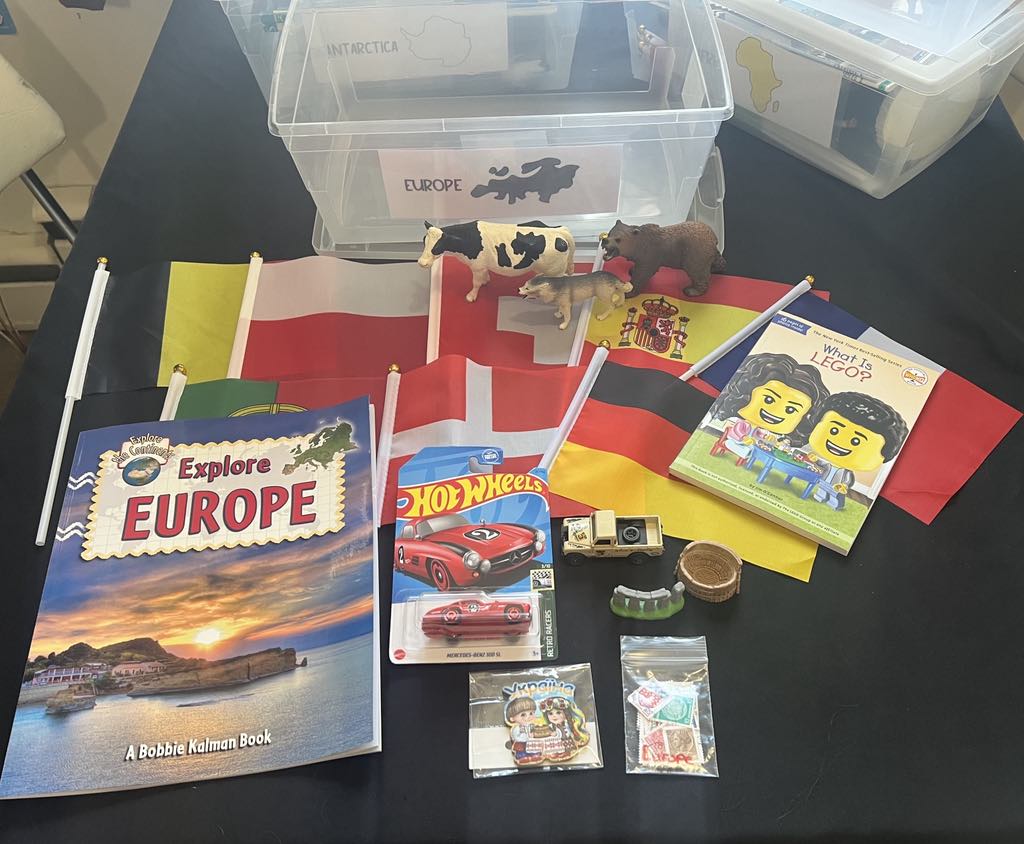
Europe Box – Explore Europe book, a book about Lego (a European toy), flags from European countries, stamps, Schleich animal figures, landmark models (Stonehenge and Colosseum), a Ukranian magnet, and even toy cars from European brands.
Step 4 – Keep adding over time
These boxes are never truly “finished.” I’m still adding reference books and learning materials to each one as I find them. Every new addition gives kids a fresh reason to explore.
Tips for Success
- Start small. You don’t need every item right away, build gradually. When I started I was a single mom with limited income. If the kids received toy animals for Christmas, I added them to the appropriate box. We used gift cards to buy books. That sort of thing.
- Mix real and replica items. A real coin or stamp adds authenticity, while miniatures make landmarks and animals accessible.
- Make it interactive. Add sorting cards, matching games or puzzles, or prompts like “Find something from Japan.”
- Let kids lead. Encourage them to add their own discoveries from trips, mail, or special events.
A Final Thought
Montessori Continent Boxes aren’t just about teaching geography, they’re about building connections. They spark questions, inspire wonder, and help children see the world as a place worth exploring, respecting, and celebrating. Whether you’re a Montessori parent, a homeschooler, or simply someone who wants to give your child a richer view of the world, these boxes can be an unforgettable part of their learning journey.